Low-carbon technologies require less extraction compared to fossil fuels, meaning that for the production and utilization of clean energy sources with lower carbon dioxide emissions, we need less extraction from mines compared to fossil fuels such as coal, oil, and natural gas. These technologies include solar, wind, nuclear, and others, which require fewer raw materials throughout their lifespan. If we want to build a low-carbon economy, we will need to extract various types of minerals. To build solar panels, we need silicon, nickel, silver, and manganese. For wind turbines, we need iron and steel, for nuclear power, uranium, and for batteries, lithium and graphite.
This raises concerns that the transition to clean energy may lead to a significant increase in global extraction.
If we look solely at the extraction requirements of a low-carbon energy system in isolation, it seems that way. We really need to extract tens to hundreds of millions of tons of minerals every year.
However, zero extraction is not the correct reference point for comparison. The relevant comparison is what we currently extract for our existing fossil fuel system. The low-carbon energy alternative is not an energy-free economy; rather, it is maintaining the status quo of a system that is predominantly supplied by fossil fuels.
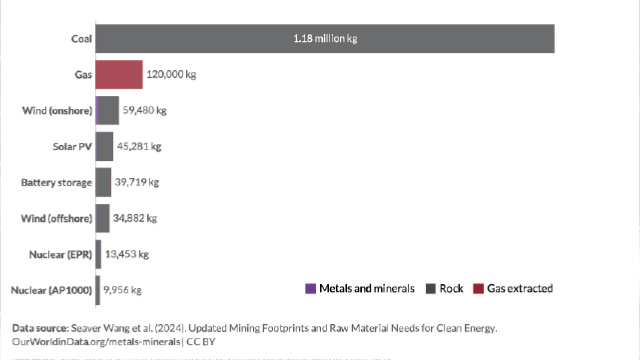
When we examine the numbers, we find that the transition to renewable energy or nuclear energy actually reduces the material requirements for electricity generation.
Let’s look at the data. Nuclear energy has the smallest material footprint. How much concrete, steel, silicon, and other materials are needed for various clean energy sources?
Siever Wang and colleagues at the Breakthrough Institute recently published an updated study examining the material requirements of various electricity sources.
This is a very recent and up-to-date assessment, which is crucial because many of these technologies have dramatically reduced their carbon footprint in recent years thanks to design and efficiency improvements. Solar panels, batteries, and wind turbines require fewer materials. Secondly, unlike other studies (which are often outdated), this study not only addresses the amount of each material needed to build electricity sources, but also calculates the total extraction requirements, including waste rock. As we will see later, this can make a big difference. Finally, this study not only addresses the metal and mineral requirements for low-carbon technologies, but also puts this in the context of the extraction footprint for fuel. Some studies address the materials needed to build a coal or gas power plant but ignore the extraction of the fuel itself.
While I focus here on the numbers from Wang et al. (2024), other high-quality studies have also reached the same conclusion: that the transition to clean energy reduces extraction for energy rather than increasing it. I have included some of these in the footnotes.
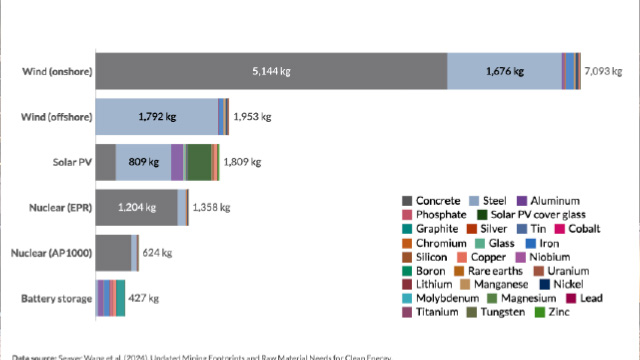
The chart below shows how much material—including metals, minerals, and concrete—is needed to generate one gigawatt-hour of electricity. For comparison, this amount of electricity consumption is roughly the annual electricity use of 230 British people.
Concrete (in gray) and steel (in light blue) typically make up the largest material footprint across all these technologies, consuming hundreds to thousands of kilograms, compared to only tens of kilograms of nickel or manganese, and a few kilograms or less of rarer elements like silver, graphite, or cobalt.
As you can see, onshore wind energy consumes significantly more materials than solar or nuclear energy, primarily due to the need for concrete. Nuclear energy—shown with two designs, the European Pressurized Reactor (EPR) and the smaller AP1000—has the lowest material footprint intensity.
Materials used for low carbon power sources
Extraction requirements for different power generation sources
Steel World Review