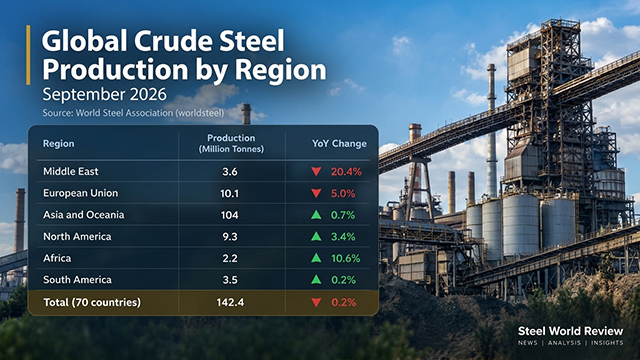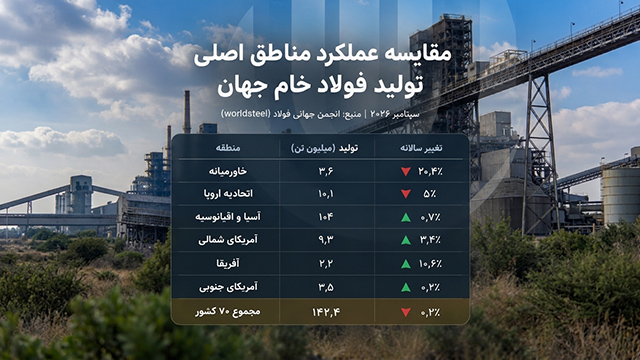
According to Steel World Review, the latest figures from the World Steel Association (worldsteel) show that crude steel production in the Middle East fell by 20.4% year-on-year to 3.6 million tonnes in September 2026. This was the steepest monthly decline among the world’s major steel-producing regions.
Meanwhile, global crude steel production declined by just 0.2% in the same month, reaching 142.4 million tonnes. The significant difference between the Middle East’s performance and the global average highlights the importance of examining the production conditions of major regional producers, particularly Iran.
What Role Has Iran Played in the Decline in Middle Eastern Steel Production?
As the Middle East’s largest crude steel producer, Iran plays a decisive role in the region’s production statistics. According to the World Steel Association’s annual data, Iran produced approximately 32 million tonnes of crude steel in 2025, a figure significantly higher than that of other countries in the region.
For comparison, Saudi Arabia’s crude steel production in 2025 was approximately 10.8 million tonnes, while the United Arab Emirates produced 3.8 million tonnes, Iraq 3 million tonnes, and Oman approximately 3 million tonnes.
This disparity indicates that changes in Iran’s production levels can have a considerable impact on the region’s overall performance indicators.
Reports published by specialised steel market media, including MEsteel and BigMint, have identified disruptions to Iran’s production and exports, associated with geopolitical conditions and logistical challenges, as among the factors contributing to the regional decline.
These media outlets have also highlighted maritime transportation difficulties along routes through the Persian Gulf, the Strait of Hormuz and the Red Sea. Such conditions have affected costs, supply chain reliability and steel trade.
However, a distinction must be made between Iran’s influence on regional performance and its numerical contribution to the decline in production. In its public September 2026 report, the World Steel Association did not disclose Iran’s monthly production figures separately. Therefore, the exact share of the Middle East’s production decline attributable to Iran cannot be determined based on this report.
Regional Production Declines by Approximately 900,000 Tonnes in One Month
According to worldsteel statistics, crude steel production in the Middle East fell from approximately 4.5 million tonnes in September 2025 to 3.6 million tonnes in September 2026.
As a result, the region recorded a year-on-year decline of approximately 900,000 tonnes in monthly production. This figure has been calculated using the rounded figures provided in the report and does not represent the exact production decline.
Furthermore, cumulative production in the Middle East during the first nine months of 2026 reached 36.9 million tonnes, representing a 9.2% decrease compared with the same period last year.
A comparison of monthly and cumulative figures indicates that the production decline in September was considerably sharper than the average decrease recorded during the first nine months of the year.
Specialised steel market reports also indicate that regional production declined by 4.6% in August. Therefore, the 20.4% drop in September points to an intensification of the downward production trend.
Global Crude Steel Production Reaches 142.4 Million Tonnes
According to the report published on 23 October 2026, crude steel production across the 70 countries reporting to the World Steel Association reached 142.4 million tonnes in September, down 0.2% compared with September of the previous year.
These countries accounted for approximately 98% of global crude steel production in 2025.
During the first nine months of 2026, their combined production reached 1.3675 billion tonnes, representing a 0.7% decrease compared with the corresponding period last year.A comparison of the performance of major steel-producing regions, as shown in the table, indicates that the Middle East experienced a significant production decline, unlike some other regions.
China and India: Two Different Production Trends
In September 2026, China produced 73.6 million tonnes of crude steel, recording a modest year-on-year increase of 0.1%. However, its cumulative production during the first nine months of the year fell by 2.9% to 724.8 million tonnes.
By contrast, India produced 13.9 million tonnes of crude steel in September, representing a 1.9% increase. The country’s production between January and September also rose by 5.6%, reaching 130 million tonnes.
Among other producers, the United States recorded an estimated production of 7.2 million tonnes, up 4.3%, while Türkiye produced 3.2 million tonnes, representing an increase of 0.8%.
What Does the Middle East’s Production Decline Mean for Iran’s Steel Industry?
The decline of more than 20% in Middle Eastern crude steel production in September highlights the need to examine the operational conditions of the region’s major producers.
Given Iran’s position in Middle Eastern steel production, a detailed analysis of this decline requires the publication of Iran’s monthly crude steel production figures and their comparison with September of the previous year.
Furthermore, assessing the factors contributing to the production decline requires separate examinations of electricity and gas supply conditions, production line shutdowns, logistical constraints and the export conditions of steel companies.
From a market perspective, a continued decline in regional production could affect steel product supply and trade flows. However, determining the direction of prices requires a simultaneous assessment of demand, inventory levels and conditions in export markets.
Overall, the World Steel Association’s September report shows that, amid relative stability in global production, the Middle East experienced an unprecedented decline in monthly performance. As the region’s largest crude steel producer, Iran is one of the key players in analysing this situation. However, determining its exact share of the production decline requires the publication of disaggregated and verifiable data.
Sources:
1. World Steel Association (worldsteel), September 2026 Crude Steel Production Report, published on 23 October 2026.
2. World Steel Association, Annual Crude Steel Production Statistics by Country for 2025.
3. MEsteel, Middle East Steel Production Status Report, 23 October 2026.
Prepared and edited by: Editorial Team of (Steel World Review)