A Deal With No Rivals, in a World Where Competition No Longer Applies
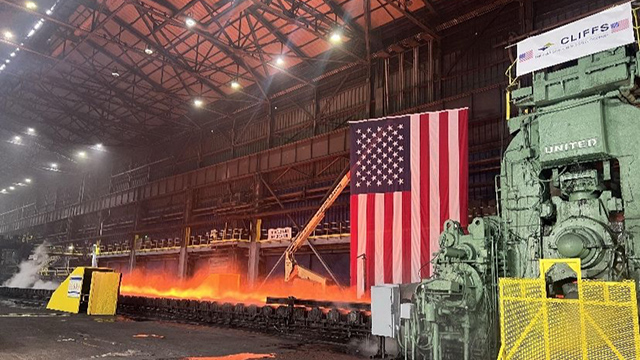
In the corridors of the Pentagon, steel is no longer merely a material for building things — it has become an instrument of survival. When the Defense Logistics Agency decided to secure the U.S. Army’s supply of grain-oriented electrical steel (GOES) through September 2030, it did not even bother holding a competitive bid. The reason was simple, and quietly unsettling: across the entire United States, only one company had the capacity to produce this specialized steel.
That company, Cleveland-Cliffs, now holds a five-year, $400 million contract — a figure that, at first glance, might seem modest against the scale of America’s defense budget, but which in practice signals a deeper structural shift: steel has moved from being an industrial commodity to a strategic asset.
When the Absence of Competition Is Itself a Warning
Normally, the absence of competition in a government contract is read as a sign of corruption or inefficiency. Here, the implication runs in exactly the opposite direction — it is a marker of industrial vulnerability. The United States, the world’s largest military economy, finds itself dependent on a single domestic producer for a material critical to its power transformers and electrical grids.
This situation mirrors a trend that has haunted America’s base industries for two decades: the gradual erosion of domestic supply chains in the face of cheaper imports, until, at the moment of crisis or strategic need, domestic options are scarce or simply do not exist. The Cleveland-Cliffs contract, in this light, is less a commercial transaction and more a corrective measure.
From the Power Circuit to the Front Line of Defense
GOES steel is a product that is invisible yet everywhere. Its unique magnetic properties have made it an inseparable component of power transformers, generators, and national electrical grids — the infrastructure on which the functioning of every modern industrial society depends. But in military applications, the same material takes on a dual role: the stability of defense systems, from communications equipment to the power grids of military bases, depends on the availability of this unassuming metal.
That is why defense officials in Washington regard it not as a spare part, but as a piece of the architecture of national security.
The New Logic of Industrial Competition
For decades, the global steel industry competed on a single, simple metric: production volume. But the Cleveland-Cliffs contract is testament to a shift in that metric. Tonnage produced no longer holds primary importance; what matters now is the capacity to produce specialized, high-value-added steel — products that define a nation’s industrial power not through cheap pricing, but through strategic application.
The implications of this shift extend well beyond a single company or a single contract: Strengthening the domestic supply chain for industries once dependent on imports is now a priority in Washington’s industrial policy.Reducing strategic dependence on foreign suppliers, particularly in areas intertwined with national security.
Drawing fresh investment toward advanced steel production, even as traditional production lines continue to struggle with stagnation.The merging of industrial policy and national security, a trend no longer confined to steel and increasingly echoed in fields such as semiconductors and critical minerals.
What Lies Behind a Single Contract
In the end, the Cleveland-Cliffs contract is less about a steelmaker in Ohio and more about a larger question: in a world where global supply chains have grown more fragile than ever, how far can nations afford to rely on a handful of domestic producers? For now, Washington’s answer is clear — pay whatever it costs to ensure that at least one supplier remains.