At a time when Iran’s industries are facing an escalating crisis in electricity and gas supply, Türkiye is building a 4,800 MW nuclear power plant with Russian investment and technology. The project, which does not involve domestic uranium enrichment, could supply around 10% of Türkiye’s electricity needs.
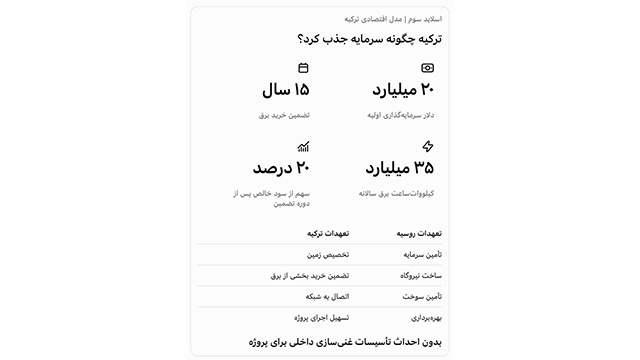
According to Steel World Review, Türkiye chose a different path for developing nuclear energy and meeting the electricity needs of its industries in 2010, when it signed an agreement with Russia. The result of this agreement is the Akkuyu Nuclear Power Plant in Mersin Province, consisting of four 1,200 MW reactors and involving an initial investment of $20 billion.
Once fully operational, the plant is expected to generate approximately 35 billion kilowatt-hours of electricity annually, a capacity that could play an important role in Türkiye’s energy security and the development of its energy-intensive industries.
Nuclear Power Without Uranium Enrichment
One of the most important features of the Akkuyu project is that no uranium enrichment takes place at the plant. Its required nuclear fuel will be supplied by Russia in ready-to-use form.
Türkiye has not made the construction of independent enrichment infrastructure a prerequisite for benefiting from nuclear energy. Instead, it has secured the investment and technology it needs through international cooperation.
This experience demonstrates that access to nuclear energy for economic and industrial development does not necessarily require an independent uranium enrichment cycle.
An Agreement with Mutual Economic Benefits
The Akkuyu Nuclear Power Plant is being developed under a Build-Own-Operate (BOO) model. Under this arrangement, Russia is responsible for financing, designing, constructing and operating the plant, as well as supplying its nuclear fuel.
In return, Türkiye has allocated the land required for the project and guaranteed the purchase of approximately 50% of the plant’s electricity for 15 years, at an average price of 12.35 US cents per kilowatt-hour.
Furthermore, after the guaranteed purchase period ends, 20% of the project company’s annual net profit will be allocated to the Turkish side.
From the perspective of attracting foreign investment and developing energy infrastructure, this agreement offers considerable economic benefits to Türkiye. Russia, in turn, will have the opportunity to recover its investment and generate long-term revenue through electricity sales and ownership of the plant. However, dependence on Russian technology and fuel, as well as the long-term commitment to purchasing electricity, are among the risks associated with the agreement for Türkiye.
The Steel Industry: A Potential Beneficiary of Türkiye’s Nuclear Power
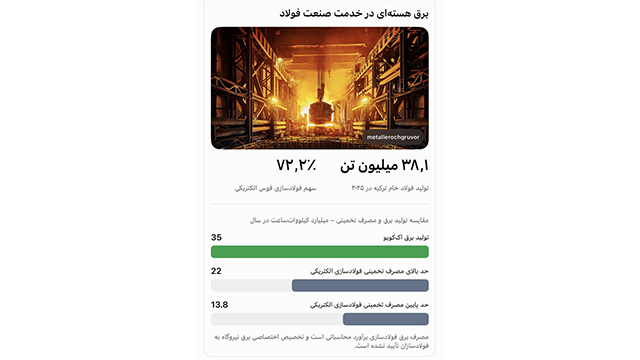
Türkiye produced approximately 38.1 million tonnes of crude steel in 2025, around 72% of which was produced using electric arc furnaces.
The Turkish steel industry’s high dependence on electricity has made the development of power generation infrastructure a key factor in its competitiveness.
Calculations indicate that Türkiye’s electric steelmaking sector may require approximately 13.8 to 22 billion kilowatt-hours of electricity annually, depending on the technology used and energy consumption intensity.
Meanwhile, the Akkuyu Nuclear Power Plant alone is expected to have an annual electricity generation capacity of 35 billion kilowatt-hours.
Although electricity from the plant will be fed into Türkiye’s national grid and will not be allocated exclusively to the steel industry, increasing power generation capacity could help reduce energy restrictions and improve the stability of industrial production.
Why Has Iran Not Been Able to Benefit from Nuclear Power to the Same Extent?
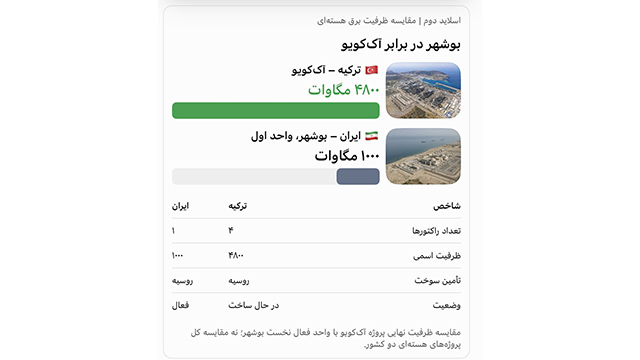
Iran has invested in nuclear technology for many years, and the Bushehr Nuclear Power Plant, with a nominal capacity of approximately 1,000 MW, is already operating. Its fuel is also supplied by Russia.
However, the expansion of Iran’s nuclear electricity generation capacity has not kept pace with the country’s growing industrial demand.
International sanctions, limited access to foreign financing, investment risks, difficulties in transferring foreign currency, electricity pricing structures and political tensions surrounding the nuclear issue have been among the obstacles to developing major energy projects in Iran.
By contrast, Türkiye has been able to use a long-term international agreement to transfer a substantial share of the responsibility for financing and constructing the plant to a foreign investor.
The nominal capacity of the Akkuyu project is equivalent to 4.8 times the capacity of the first unit of the Bushehr Nuclear Power Plant, although Akkuyu has not yet reached full operation.
Nuclear Energy in the Service of Economic Development
Türkiye’s experience shows that nuclear policy can be directly linked to industrial development objectives, energy security and increased export capacity.
For a country such as Iran, whose steel, mining, petrochemical and cement industries face extensive energy constraints, examining successful models of financing and international cooperation in the energy sector is particularly important.
The fundamental question is how investment in nuclear technology can be translated into an actual increase in electricity generation capacity, economic growth and reduced energy constraints for industries.
The economic success of a nuclear power generation programme should be measured by the amount of electricity it can deliver to the grid, the reliability of electricity supply, and the added value it creates for the national economy and industries.
 |  |