Persian Gulf water has reached the heart of Isfahan’s industry.
Inauguration of the mega project for transferring seawater to Iran’s Central Plateau, led by Mobarakeh Steel a strategic step toward eliminating industrial dependence on the Zayandeh-Rood River and creating the foundation for an industrial water market.
According to the Iranian Steel Specialized Media – Steel World Review, on the morning of Saturday, Azar 15, 1404 (December 6, 2025), the first phase of the national mega-project for transferring seawater to Iran’s central plateau was inaugurated by order of Masoud Pezeshkian, the President, with the presence of Seyed Mohammad Atabak, Minister of Industry, Mining and Trade, and Saeed Zarandi, CEO of the Mobarakeh Steel Group, via online connection to the Mobarakeh Steel Complex in Isfahan.
This project, which has delivered water from the Persian Gulf along the Sirjan-Isfahan route, aims primarily to reduce the dependency of the province’s major industries on the Zayandeh-Rood river basin and groundwater resources, while establishing a sustainable infrastructure for the industrial development of Isfahan.
The Role of Mobarakeh Steel in Steel Supply and Project Advancement
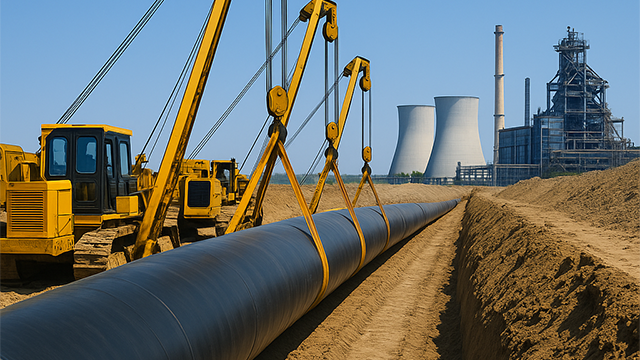
According to an exclusive report by Chilan, the mega-project for transferring seawater to Isfahan has been completed with an estimated cost of approximately 35 trillion rials. Mobarakeh Steel contributed significantly to this project by supplying around 600,000 to 610,000 tons of steel sheets—including API X65 grades and special steels designed for high pressure and high-grade applications for the construction of an over 800-kilometer pipeline from Sirjan to Isfahan, accounting for roughly 42% of the project’s advancement and completion.
According to Saeed Zarandi, CEO of Mobarakeh Steel Group, a significant portion of the pipeline route approximately 530 kilometers—has been designed as a gravity-flow system to eliminate the need for multiple pumping stations and minimize electricity consumption. This approach makes the project a notable national example in terms of energy efficiency.
Zarandi also emphasized that the project involved 42 contractors and approximately 3,000 personnel, and that executing the pipeline installation on this scale over roughly two years sets a national record.
Reducing Pressure on the Zayandeh-Rood River and Paving the Way for an Industrial Water Market
At the project inauguration ceremony, the President emphasized that the main objective of this initiative is to reduce the additional burden on the Zayandeh-Rood River and groundwater resources, thereby freeing up more water for local communities and environmental water rights. He described the Zayandeh-Rood as a “right of the region’s people” and stated that with the operation of this project, it will be possible to allocate more water to the river’s flow and downstream wetlands, particularly the Gavkhuni Wetland.
Saeed Zarandi also introduced this project as a prelude to the formation of an “industrial water market for the province and neighboring industries.” Such a market could, through economic and managerial mechanisms, make industrial water consumption more transparent, monitorable, and efficient, while creating the foundation for reducing waste and enhancing productivity.
According to him, Mobarakeh Steel previously consumed less than 1.5% of the Zayandeh-Rood’s water. However, embracing its social responsibility, the company has joined a project aimed at reducing the dependency of all major provincial industries on this river basin. Alongside this initiative, Mobarakeh Steel has also planned extensive programs for electricity self-sufficiency including the development of solar power plants and increasing electricity generation capacity by approximately 400 MWto simultaneously strengthen both energy and water sustainability.
Technical and National Details of the Seawater Transfer Project
According to official reports, in this phase of the project, approximately 800 kilometers of large-diameter pipelines (around 1,600 and 2,000 millimeters) have been installed, and the supply, design, and execution of the project have been carried out entirely using domestic capabilities.
According to official reports, in this phase of the project, approximately 800 kilometers of large-diameter pipelines (about 1,600 to 2,000 millimeters) have been installed, with the supply, design, and execution fully carried out using domestic capabilities.
According to executive managers, in the current phase, water is being sourced through a connection to the Kerman and Yazd Industrial Water Supply Project and transferred to Isfahan. In the next steps, the construction of a dedicated pipeline from the Oman Sea coast to Isfahan is planned to provide a sustainable and independent water supply for the province’s industries.
Emphasis on Sustainable Development and Environmental Considerations
Mehdi Jamalizadeh, Governor of Isfahan, described the project at the ceremony as an example of “willpower triumphing over geography,” stating that its implementation utilized advanced desalination and energy recovery technologies, while efforts were made to keep the carbon footprint, pollutants, and process waste to an absolute minimum.
At the same time, officials’ emphasis on restoring the Gavkhuni Wetland and preserving the Zayandeh-Rood’s environmental water rights has made this project one of the key pillars of national water policy. Successful implementation of this initiative could serve as a model for other river basins and similar projects in Iran provided that its regulatory, environmental, and economic mechanisms are designed and executed transparently and sustainably.
Summary: A Milestone for Isfahan’s Steel Industry and Water Governance
The inauguration of the mega-project for transferring seawater to Isfahan can be considered a milestone for the steel industry and water governance in Iran’s central plateau. On one hand, by reducing the dependency of Mobarakeh Steel and other major industries on the Zayandeh-Rood River and groundwater resources, the project enhances the industrial and urban resilience of Isfahan against drought. On the other hand, it lays the groundwork for new infrastructures such as an industrial water market, the expansion of renewable energy in the steel sector, and improved water-use efficiency.
Given the environmental, social, and economic complexities of this project, the practical realization of goals such as “reducing the burden on the Zayandeh-Rood,” “restoring the Gavkhuni Wetland,” and “achieving sustainable industrial development” in the coming years will serve as a key indicator for assessing the success of the seawater transfer mega-project to Isfahan, drawing attention from stakeholders in the steel industry, environmental sector, and water policy-making.
Sources:
Chilan Online, IRNA, ILNA, IRIB News Agency, Fararu, and data from the National Seawater Transfer Project to Iran’s Central Plateau.