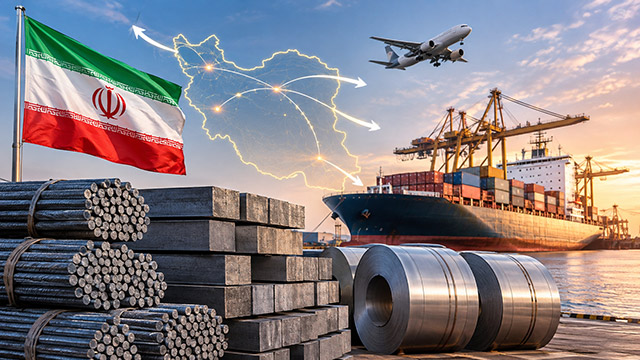
With increasing restrictions on maritime transportation and disruptions at border crossings, Iran’s steel export routes have undergone changes. The latest market reports indicate that billet and slab trading has resumed, but exports continue to face higher freight costs, border restrictions, and logistical risks.
According to Steel World Review, Iran’s steel export routes in November 2026 have been affected by restrictions on maritime transportation, disruptions to cross-border traffic, and rising logistics costs. Under current conditions, Iraq’s land borders, maritime routes through the Persian Gulf, and connections with Southeast Asian markets are among the key routes mentioned in recent reports on Iranian steel transactions.
According to a November 13, 2026 report by Shanghai Metals Market, new deals for Iranian billets and slabs have been recorded following several weeks of reduced export activity. These developments come as restrictions on passage through the Strait of Hormuz and increased maritime shipping risks continue to affect the country’s steel trade.
Iraq: An Active Land Route for Steel Exports
Iraq remains one of the most important regional markets for Iranian steel products. Its geographical proximity and the availability of road transportation have made it one of the main land export routes for billets and steel products.
According to Shanghai Metals Market’s November 13 report, Iranian billet offers at the Iraqi border were in the range of $420–430 per tonne on an FCA basis.
The report also noted the reopening of an Iraqi border crossing that had been closed since October 21. Despite the reopening, sellers continue to insist on receiving payment before delivering the goods.
In recent weeks, border restrictions had led to the suspension or reduction of some Iranian steel product transactions with Iraq. Market reports also indicated that previous deals for Iranian hot-rolled coil at the Iraqi border had been in the range of $545–560 per tonne.
Persian Gulf: Export Deals Continue Despite Maritime Disruptions
The southern maritime route of Iran, particularly through its southern ports, remains important for trade in semi-finished steel products, although transportation conditions in the Persian Gulf face considerable restrictions.
According to the November 13 report by Shanghai Metals Market, an Iranian producer concluded a contract to sell 30,000 tonnes of steel billets to buyers in Gulf Cooperation Council countries at $432 per tonne FOB, with delivery scheduled for December.
Freight costs for this shipment were reported at approximately $22–28 per tonne.
Southeast Asia: Destination for a New Iranian Slab Shipment
Southeast Asian markets have also featured in the latest Iranian steel export transactions.
According to Shanghai Metals Market, the first Iranian slab export contract after several weeks of inactivity was concluded for a shipment of 40,000–50,000 tonnes at $428–430 per tonne FOB.
The shipment’s destination was reported to be Southeast Asia, with transportation scheduled for late December 2026.
This transaction indicates that Iranian slab producers continue to maintain trade links with Asian buyers, although shipment execution remains dependent on maritime route conditions.
Turkey: A Land Connection to Western Markets
Turkey is one of the important land routes for Iran’s trade with Western markets. The Bazargan border crossing and the Razi rail connection are among the main transportation routes between the two countries.
However, recent reports indicate truck congestion, restrictions on the admission of freight vehicles, and longer waiting times at the Bazargan border.
According to reports published in October and November, restrictions on truck transit capacity at this crossing have made the Turkish route more challenging for exporters.
Although Turkey is an important land transportation option for Iranian industrial products in terms of infrastructure, no specific steel export contract through this route in November 2026 has been confirmed in the recent reports reviewed.
The Caspian Sea and Northern Corridors: Alternative Routes for Foreign Trade
Restrictions at southern ports have increased attention to Iran’s northern routes. Caspian Sea ports and land and rail connections with Azerbaijan, Turkmenistan, and Russia are among the options considered for transporting goods.
The Astara route in the northwest and the Sarakhs and Incheh Borun crossings in the northeast provide Iran with access to regional transportation networks.
However, limited capacity in some infrastructure facilities and the incomplete sections of the railway network constrain the wider use of these corridors.
Rising Transportation Costs and Border Restrictions
Alongside changes in export routes, rising transportation costs have become one of the main challenges facing steel exporters.
Recent steel market reports point to higher maritime freight costs, the temporary suspension of some transactions, and more difficult access to export markets.
In late October, restrictions at the Iraq and Pakistan borders, together with maritime transportation problems, had led to a sharp decline in Iranian steel export transactions. However, the conclusion of new billet and slab contracts in mid-November indicates that part of the export activity has resumed.
According to the latest published information, the Iraqi border and maritime transactions with buyers in the Persian Gulf and Southeast Asia provide the clearest evidence of Iranian steel export activity in November 2026. The Turkish route and northern corridors are also important in terms of trade access, but disaggregated transportation and customs statistics are required to assess their actual share of steel exports.
Sources: Shanghai Metals Market, reports dated October 23 and 30 and November 6 and 13, 2026; Deutsche Welle, September 14, 2026; Reuters, November 9, 2026.